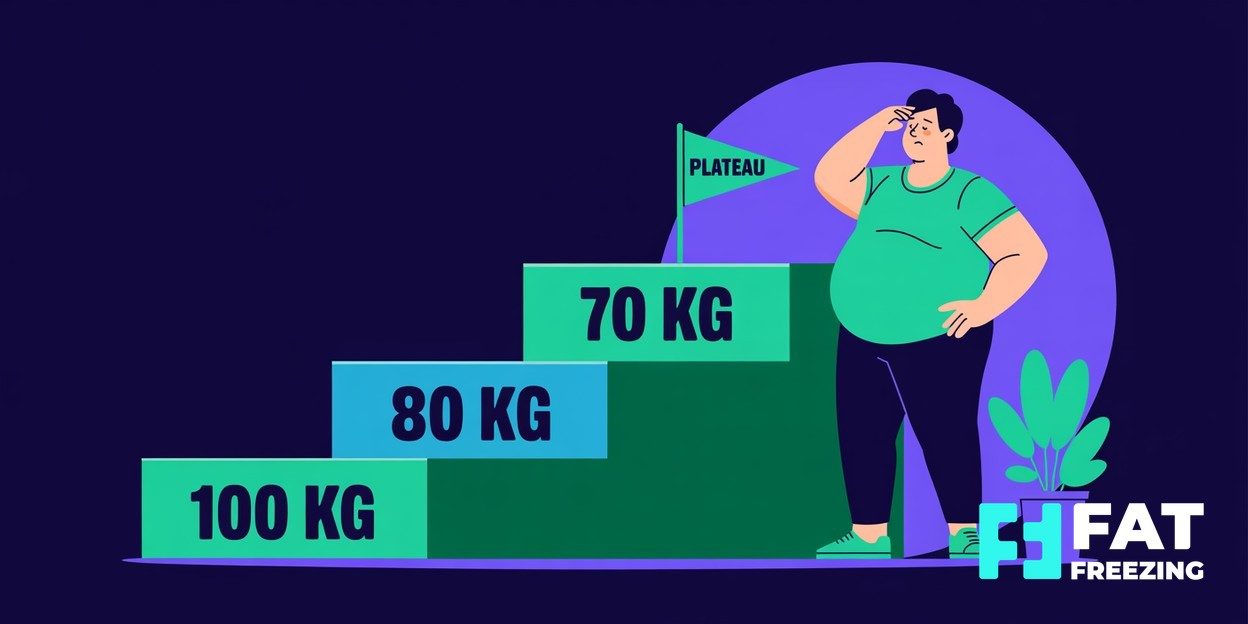
Two people start the same year. Both lose half a stone. One of them looks noticeably different in photographs, has dropped a dress size and feels stronger. The other looks softer than before, is more tired, and cannot work out why the mirror has not caught up with the scale.
The scale gave both of them the same number, because the scale is not measuring what either of them actually cared about.
Weight and fat are two different quantities
This sounds obvious written down, and almost nobody acts on it.
Weight loss means reducing your total body mass. Everything counts: fat, muscle, bone, organs, the water in your tissues, the glycogen stored in your liver and muscles, and whatever you ate last night. Fat loss means reducing the volume and the number of fat cells in your body. Those two numbers can move in the same direction, in opposite directions, or one can move while the other sits still.
A set of bathroom scales cannot distinguish between them. It gives you one number for the whole system, and then you are left to guess what changed inside it.
The bit of the number that is not fat
This matters more than it used to, because a large share of UK weight loss now happens quickly, on medication.
Body composition data from the SURMOUNT-1 trial found that over 72 weeks, fat mass fell by 33.9% while lean mass fell by 10.9%. Put differently, roughly three quarters of the weight lost was fat, and roughly a quarter was lean tissue, including muscle.
A quarter is not a rounding error. It is the difference between finishing a year of hard work looking lean and finishing it looking deflated. Muscle is the tissue sitting underneath your skin giving it something to sit against; lose enough of it alongside the fat and the result reads as gaunt rather than trim, particularly in the face. It is also metabolically expensive tissue, so losing it makes maintaining the loss harder afterwards.
The fix is not complicated and it is well established: keep protein high and keep doing resistance training throughout, not after. That does not stop the fat loss. It changes what the fat loss leaves behind. If you are weighing up injections against other routes, we have compared them directly in fat freezing versus Mounjaro.

Why BMI cannot see the difference either
The obvious next move is to check your BMI, and BMI has the same blind spot for the same reason.
It is worth knowing where the number came from. It was derived in the 1830s by Adolphe Quetelet, a Belgian mathematician and astronomer who was not a physician, working from data on white European men, and his goal was to describe a statistical "average man" for social science. It was not applied to health until the 1970s, when the physiologist Ancel Keys studied 7,426 men and concluded it was the most practical tool available for population-level obesity research. It has been a population screening instrument its entire life.
Used on one person it has five well-documented failure modes:
- It cannot separate muscle from fat. Muscle is denser, so a strong person reads heavier. Athletes routinely register as overweight or obese with low body fat, and people with a perfectly normal BMI can carry high visceral fat, a pattern sometimes called "normal-weight obesity".
- It ignores where the fat is. Two people at the same BMI can have completely different metabolic risk depending on whether the fat is around the hips or around the organs.
- It varies by sex. Women naturally carry 5 to 10 percentage points more body fat than men at the same BMI.
- It varies by age. Body composition shifts towards less muscle and more fat over the years with no change in BMI at all.
- It varies by ethnicity. Metabolic risk starts at meaningfully lower BMI values for several groups, which is why the NHS and NICE apply reduced thresholds, with overweight from BMI 23 and obese from 27.5 for South Asian adults. An analysis of over 1.4 million people in England put the South Asian equivalent of a white European BMI of 30 at 23.9.
The BMJ, NICE and the British Medical Association have all published commentary along these lines, and in 2023 the American Medical Association formally resolved to de-emphasise BMI as a standalone metric. It remains a reasonable first filter. Our BMI calculator will give you the number, and our longer piece on what BMI actually means explains where to stop trusting it.
What to measure instead
Three measures do the job BMI cannot, and none of them needs a clinic.
| Measure | How to take it | Healthy range |
|---|---|---|
| Waist-to-height ratio | Waist circumference divided by height | 0.5 or below, and it works across ethnic groups |
| Waist-to-hip ratio | Waist divided by hips | 0.90 or below for men, 0.85 or below for women |
| Body fat percentage | DEXA, bioimpedance or calipers | Roughly 10 to 20% for men, 18 to 28% for women |
Waist-to-height ratio is the one to start with. It needs a tape measure, it captures fat distribution rather than just mass, and unlike BMI it does not need adjusting for your background.
Add monthly photographs in the same light and the same clothes, and pay attention to how a specific garment fits. If you want to keep weighing yourself, keep weighing yourself. Just treat the number as one input in a trend rather than the verdict on your month. Our weight loss goal calculator is built around that trend rather than a single reading.

Why some fat stays put whatever the scale does
There is a second reason the scale disappoints people, and it has nothing to do with muscle.
Fat does not leave the body evenly, and you cannot choose where it leaves from. A 2021 meta-analysis of 13 studies covering more than 1,100 participants found that localised muscle training had no effect on localised fat, and a randomised trial found no significant difference in abdominal fat between women who dieted alone and women who added twelve weeks of abdominal training. Sit-ups do not empty the fat above the muscle you are working.
Which fat goes first is largely decided for you. Alpha-2 adrenergic receptors, which actively inhibit fat breakdown, are more concentrated in some depots than others, and they cluster in the hips, the thighs and the lower abdomen. That is the physiology behind the very common experience of reaching a healthy weight and still carrying a pocket of fat that will not shift.
It also explains a genuinely important split. Visceral fat, the deep fat around your organs, responds well to diet and exercise and is the fat that matters most for your health. Stubborn subcutaneous fat, the pinchable layer just under the skin, responds poorly and matters mostly to how you look. We go deeper into this in fat freezing versus diet and exercise and in why losing weight is harder for some people.
Where fat freezing sits in all this, honestly
This is the point where a clinic usually tells you the answer is a treatment. The honest version is narrower than that.
Fat freezing reduces the fat layer in a treated area by around 20 to 25% per session, which is well evidenced. What it does not do is change the number on your scale. It is a fat reduction and body contouring treatment, not a weight loss procedure, and most patients see no significant change in body weight at all. The results turn up as inches from a treated area, as photographs, and as how a waistband sits.
That is not a limitation being spun as a feature. It is the whole mechanism: you are removing a modest volume of fat from one place, not reducing total body mass. It is also why the treatment is aimed at people already close to their target weight, with pinchable subcutaneous fat and a stable weight, rather than at people with a lot to lose. It is described in the clinical literature as the finishing touch, not the foundation, and it will not touch visceral fat at all.
Results take time, too. Nothing is visible on the day, the first changes show at three to four weeks, and the full effect settles at three to four months. There is more detail in what results to expect.
So if you weigh yourself the week after a session and nothing has moved, nothing has gone wrong. You were measuring the wrong thing, with the wrong instrument, on the wrong timescale.
Get a tape measure. Take the photographs. Keep the protein up and keep lifting something heavy. And if what is left after all that is a specific, pinchable pocket that has ignored two years of genuine effort, that is the point at which a conversation about treating it directly starts to make sense.
What the scale genuinely tells you
- A reliable trend line over weeks, which is the only way to confirm a real calorie deficit
- An early warning of fluid retention or a stalled deficit that photographs alone will miss
- A free, fast, repeatable number you can take at home every week for years
What it quietly hides
- It cannot separate fat from muscle, bone, water, glycogen or last night's dinner
- It moves barely at all for treatments that change your shape in one specific area
- It can go down while your body composition gets worse, which is exactly what happens when a quarter of the loss is lean tissue
Frequently Asked Questions
Can you lose fat without losing weight?
Yes, and it is common. If you lose fat and build muscle at a similar rate, the scale barely moves while your measurements and your clothes change noticeably. The same thing happens with localised fat reduction treatments, which remove fat from one area without changing total body mass enough to register.
How much of GLP-1 weight loss is fat?
Roughly three quarters. Body composition data from the SURMOUNT-1 trial found fat mass fell 33.9% while lean mass fell 10.9% over 72 weeks, so about a quarter of the total weight lost was lean tissue. Resistance training and adequate protein are the recognised way to shift that ratio in your favour.
Does fat freezing make you lose weight?
No, and expecting it to is the most common reason people are disappointed. Cryolipolysis reduces the fat layer in a treated area by around 20 to 25%, but most patients see no meaningful change on the scale. Results show up as inches, photographs and how clothes fit.
Is BMI useless then?
Not useless, but it is being asked to do a job it was never designed for. It was built in the 1830s as a population statistic, not an individual health measure, and it cannot see the difference between muscle and fat. It works as a rough screening tool and fails as a verdict on one person.
What should I measure instead of weight?
Waist circumference is the single most useful addition, ideally as a waist-to-height ratio, where under 0.5 is the general target. Add monthly photographs in the same light and the same clothes, and keep weighing yourself if you find it useful, but treat it as one input rather than the score.