Fat Freezing in 2026: Trend, Treatment or Something In Between?
Few aesthetic treatments have generated quite as much conversation over the past decade as fat freezing. Known clinically as cryolipolysis, the technique has been celebrated as a genuine alternative to liposuction, dismissed as overhyped marketing, and more recently overshadowed by the rapid rise of GLP-1 weight loss injections. So as we move through 2026, a fair question to ask is whether fat freezing is a fad that has run its course, or a credible treatment that simply needs reframing for a new era.
The honest answer sits somewhere between the two extremes. Cryolipolysis is FDA cleared, supported by nearly two decades of clinical evidence, and has been used in more than seventeen million procedures worldwide. Yet according to the American Society of Plastic Surgeons, non-invasive fat reduction treatments dropped by roughly 40% between 2023 and 2024, falling from 745,967 procedures to 447,581. That is a significant shift in consumer behaviour, and it deserves a proper explanation rather than a sound bite.
What This Article Covers
We will explore where fat freezing came from, what the science actually says, why demand has shifted, and what real people are choosing for body sculpting in 2026. We will also look honestly at the alternatives, including fat dissolving injections, ultrasound cavitation, EMSculpt and GLP-1 medications such as Mounjaro, so you can decide whether cryolipolysis still has a place in your own plans.

The Origins: How Fat Freezing Emerged
Cryolipolysis was developed in 2007 by researchers at Harvard who observed that fat cells were more vulnerable to cold than surrounding tissues such as skin, nerves and blood vessels. By 2010, the first device received FDA clearance for treating love handles, with further approvals soon following for the abdomen, thighs, back, bra fat, chin and the area underneath the buttocks. You can read more about this journey in our overview of the history of fat freezing.
Unlike a fashion-driven fad, cryolipolysis was built on a clear biological mechanism: lipid-rich adipocytes crystallise at temperatures higher than the freezing point of water in surrounding tissues. Controlled cooling between roughly 30 and 39 degrees Fahrenheit triggers selective fat cell injury, followed by a natural inflammatory response in which the body gradually clears damaged cells over the following weeks. We explore this process in detail on our fat freezing science page.
What the Evidence Actually Shows
Reviewing the clinical literature paints a far more measured picture than either the hype or the backlash suggests. A 2015 review published in the Aesthetic Surgery Journal reported an average fat-volume reduction of 19.5% after four months across 295 patients. A separate analysis in Plastic and Reconstructive Surgery found average fat reductions of 14.7% to 28.5% in treated areas, with higher figures after a second session.
More recent meta-analyses confirm meaningful reductions in waist circumference, suprailiac fat thickness and body mass index at twelve weeks, with patient satisfaction rates consistently between 80% and 92%. None of those figures describes a fad. They describe a maturing, evidence-supported treatment with predictable, if modest, outcomes. For a deeper look at typical outcomes, see what results to expect from fat freezing.
Cryolipolysis is not a fad in the traditional sense. It is a clinically validated treatment whose role is being redefined as new alternatives reshape the body contouring landscape.
So Why Has Demand Fallen?
If the science remains sound, why has demand dropped so sharply? The answer lies primarily in the rise of GLP-1 receptor agonist medications such as semaglutide and tirzepatide, sold under brand names including Wegovy, Ozempic and Mounjaro. These injections offer something cryolipolysis was never designed to deliver: substantial, whole-body weight loss alongside metabolic improvements.
For patients with significant fat to lose, GLP-1s present a compelling option. They reduce appetite, address cravings and influence systemic fat distribution. By contrast, cryolipolysis was always intended for localised, stubborn fat in patients close to their ideal weight. The market has effectively re-sorted itself, with people now choosing the right tool for their actual goal rather than defaulting to whichever treatment had the strongest brand presence. We compare these directly in fat freezing vs Mounjaro.
Other Factors Behind the Decline
- Cost stacking: achieving full results often requires multiple sessions across several areas, which can quickly become expensive.
- Realistic expectations: patients expecting dramatic results sometimes felt underwhelmed by the gradual, modest changes cryolipolysis actually delivers.
- Newer technologies: radiofrequency, HIFU, ultrasound cavitation and electromagnetic muscle-building devices have broadened the menu of options.
- Concerns about paradoxical adipose hyperplasia (PAH): a rare but well-publicised complication, especially in male patients.
Fat Freezing in 2026: A Balanced View
Why It Still Has a Place
- FDA cleared with over 17 million procedures performed worldwide
- No surgery, no anaesthesia and no downtime
- Permanent reduction of treated fat cells when weight is maintained
- Excellent for stubborn, localised fat after weight loss or pregnancy
- Works well in combination with skin tightening or muscle-building treatments
- High patient satisfaction (80 to 92% across studies)
Why It Is Not For Everyone
- Not suitable for overall weight loss or obesity
- Results are gradual, taking 8 to 16 weeks to fully appear
- Multiple sessions are often needed for larger or multiple areas
- Rare risk of paradoxical adipose hyperplasia, more common in men
- Less impactful than GLP-1 medications for whole-body fat reduction
- Will not improve visceral fat or metabolic health markers
What Real People Are Choosing in 2026
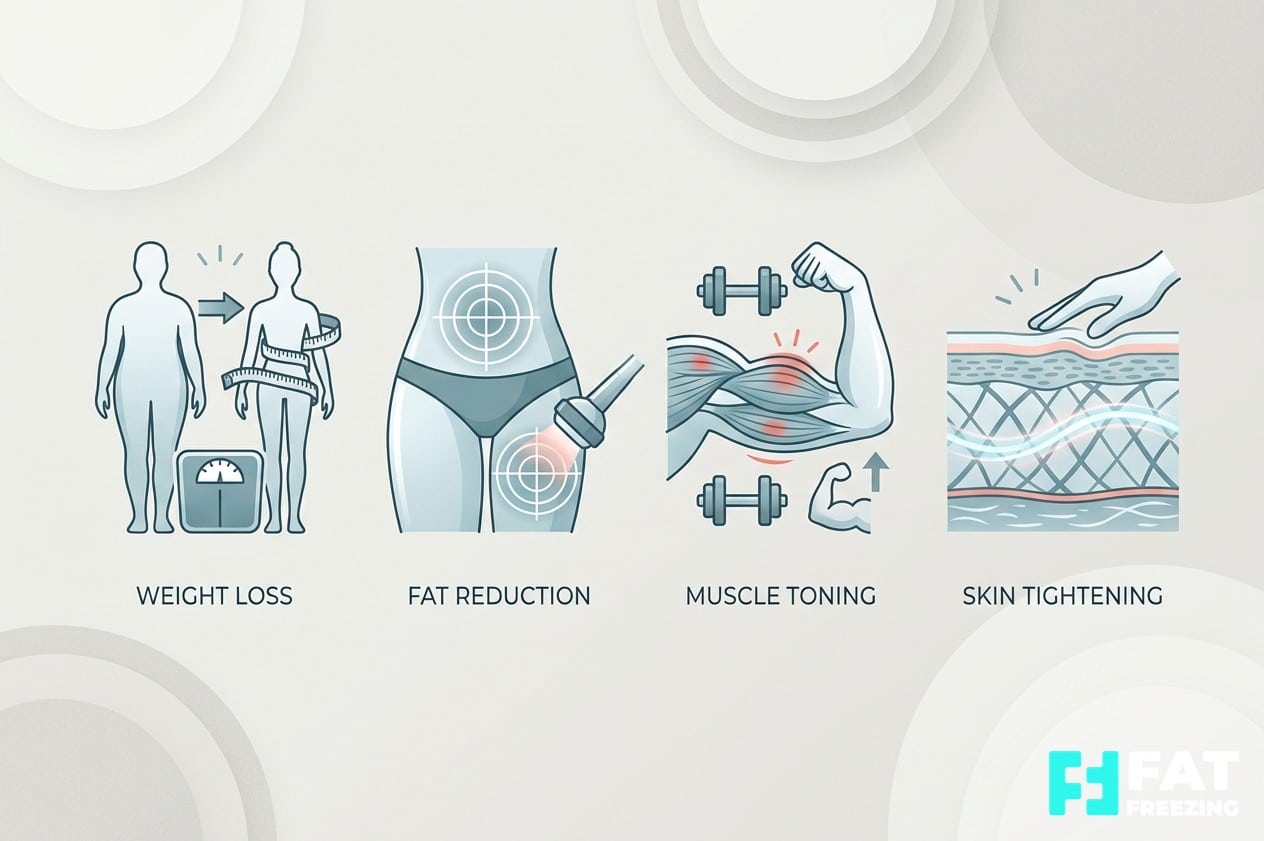
Body contouring in 2026 is rarely a single-treatment decision. Most clinics now design layered protocols that combine systemic weight loss, targeted fat reduction and tissue-tightening technologies. The most popular pathways we see include the following combinations.
1. GLP-1 Medication Followed by Targeted Contouring
Patients who have lost significant weight on Mounjaro or Wegovy often find pockets of stubborn fat remain in the abdomen, flanks or inner thighs. Cryolipolysis or Aqualyx fat dissolving injections are ideal for these areas. For a comparison, our guide on Aqualyx vs Mounjaro explains how the two work together rather than against each other.
2. Fat Reduction Plus Muscle Building
Combining fat freezing with EMSculpt has become one of the most requested protocols. Cryolipolysis reduces the fat layer while EMSculpt builds underlying muscle tone, producing a more sculpted result than either treatment achieves alone.
3. Skin Tightening as a Finishing Step
After significant weight loss, loose skin is a common concern. HIFU body tightening and radiofrequency treatments are increasingly used alongside fat reduction to refine the final result.
4. Non-Freezing Alternatives
Some patients prefer non-cold approaches entirely. Ultrasound cavitation uses sound waves to disrupt fat cells, while Lemon Bottle and Aqualyx use injectable solutions to break down fat. We compare these in fat freezing vs ultrasound cavitation and cryolipolysis vs Aqualyx.
Safety: What the Long-Term Data Tells Us
One of the strongest arguments against the fad label is the depth of long-term safety data. The most common side effects of cryolipolysis are transient: redness, mild swelling, bruising, temporary numbness and short-term tenderness, all typically resolving within a few days to a couple of weeks. Long-term follow-up studies have found no abnormal lipid levels, no liver function changes and no evidence of nerve damage following treatment.
Paradoxical adipose hyperplasia, where the treated area becomes firmer and larger rather than smaller, remains the most clinically significant rare complication. Reported incidence varies from approximately 1 in 4,000 to 1 in 138 cases depending on the dataset, and risk appears higher in male patients. We discuss this transparently in our article on when fat freezing goes wrong.
Following correct aftercare meaningfully improves outcomes and minimises side effects. Our guide on cryolipolysis aftercare outlines the small steps that make a real difference.
Is Fat Freezing Still Worth Considering?
For the right candidate, absolutely. If you are within roughly 10 to 15% of your goal weight and frustrated by stubborn pockets of fat that resist diet and exercise, cryolipolysis remains one of the most practical and well-studied options available. It is non-invasive, requires no downtime, and produces permanent reduction of treated fat cells. It is also one of the few treatments that pairs comfortably with almost every other body sculpting modality.
If your goal is significant weight loss, however, fat freezing was never the right tool, and that has become clearer in 2026 thanks to better-informed conversations between clinicians and patients. A GLP-1 medication or a structured weight management plan is likely to serve you better, with cryolipolysis potentially playing a supporting role afterwards. Our article on fat freezing vs diet and exercise offers a useful starting point for setting expectations.
The decline in demand reflects a smarter market, not a failed treatment. People are simply matching the tool to the job more accurately than they used to.
The Verdict
So, is fat freezing a fad? Not in any meaningful sense. A fad is built on hype with little substance behind it, fades when the novelty disappears, and leaves nothing of value once the trend passes. Cryolipolysis, by contrast, is supported by nearly two decades of peer-reviewed research, FDA clearance, millions of treatments and consistently high satisfaction rates. What has changed is the wider context in which it sits.
In 2026, the smartest approach is no longer to ask whether fat freezing works, because it clearly does for the right candidate. The better question is whether it is the right treatment for your specific goal, body type and lifestyle. For some people, the answer will be yes. For others, a GLP-1 medication, fat dissolving injection, ultrasound cavitation session or muscle-building protocol will be a better fit. The good news is that you no longer have to choose just one.
Frequently Asked Questions
Is fat freezing actually backed by science, or is it just clever marketing?
Cryolipolysis is supported by a substantial body of peer-reviewed research, including multiple meta-analyses showing average fat reductions of 15 to 28% in treated areas. It is FDA cleared, has been used in over 17 million procedures worldwide, and has consistent patient satisfaction rates of 80 to 92%. While marketing has certainly amplified its profile, the underlying science is genuine.
Why has fat freezing become less popular recently?
The main reason is the rise of GLP-1 weight loss medications such as Mounjaro, Wegovy and Ozempic. These offer significant whole-body weight loss, which cryolipolysis was never designed to provide. As patients have become better informed, many now choose GLP-1s for overall weight reduction and reserve fat freezing for refining stubborn localised areas afterwards.
Should I choose fat freezing or a GLP-1 like Mounjaro?
It depends entirely on your goal. If you want to lose a meaningful amount of weight or improve metabolic health, a GLP-1 medication is generally the better choice. If you are close to your ideal weight and want to address specific stubborn pockets such as the lower abdomen, flanks or inner thighs, cryolipolysis is well suited. Many people use both in sequence for a comprehensive result.
How long do fat freezing results last?
The fat cells destroyed during cryolipolysis are permanently removed and cannot regenerate. Long-term studies, including patients followed for up to nine years, have shown durable reductions in treated areas. However, the remaining fat cells can still expand if you gain weight, so maintaining a stable weight is important to preserve results.
Is fat freezing safe?
Cryolipolysis has a well-established safety profile. The most common side effects, including redness, swelling, bruising and temporary numbness, are mild and resolve within days or weeks. Serious complications such as paradoxical adipose hyperplasia are rare. Long-term studies have found no negative effects on liver function, lipid levels or nerve health.
Can fat freezing replace liposuction?
Not entirely. Liposuction can remove a much larger volume of fat in a single procedure, often up to 80%, but it requires anaesthesia, surgical recovery and carries higher risks. Cryolipolysis offers a non-invasive alternative with no downtime but produces more modest results, typically 20 to 25% reduction per session. Our comparison of fat freezing vs liposuction explains the differences in detail.